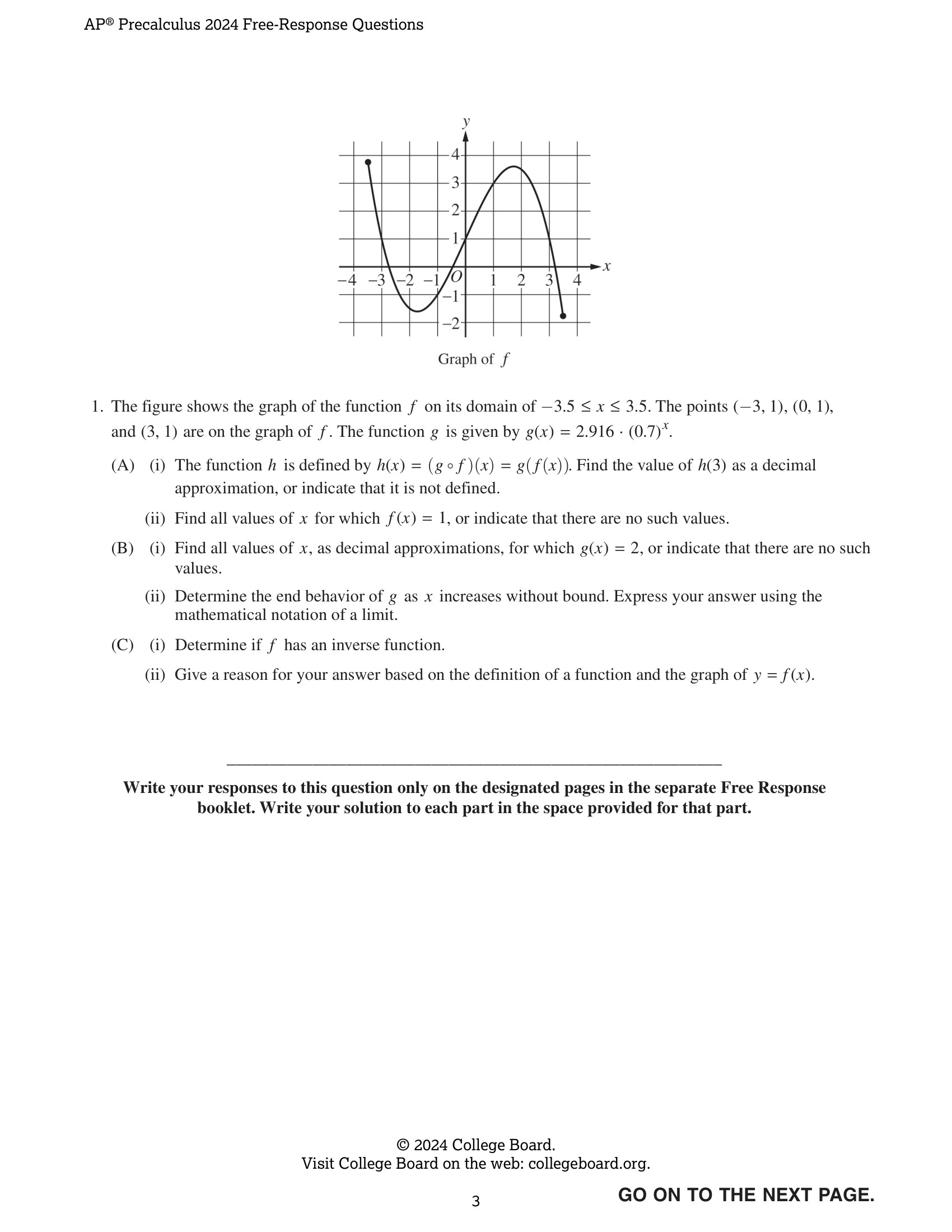
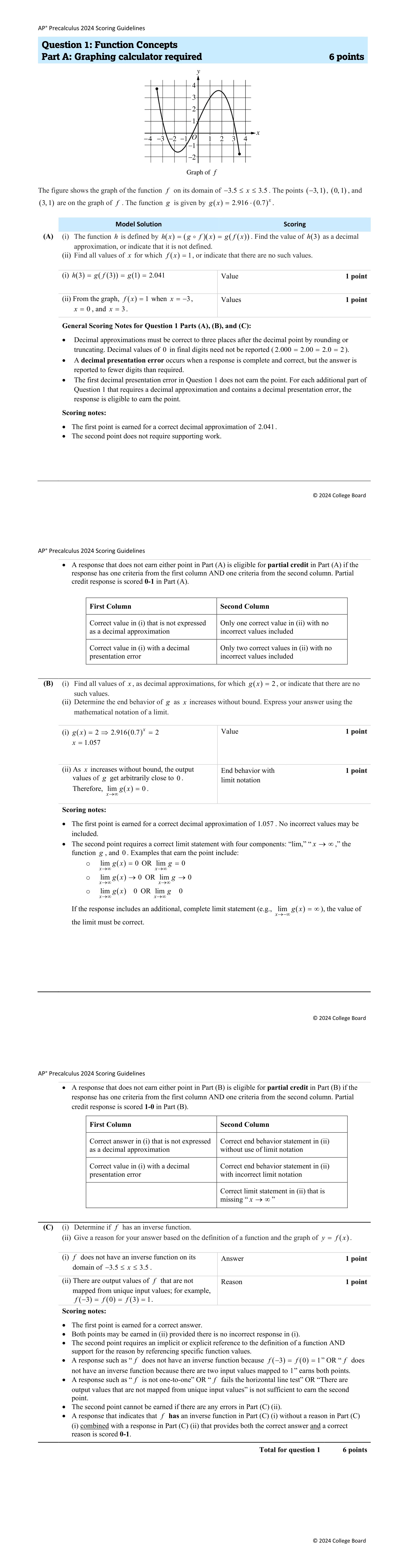
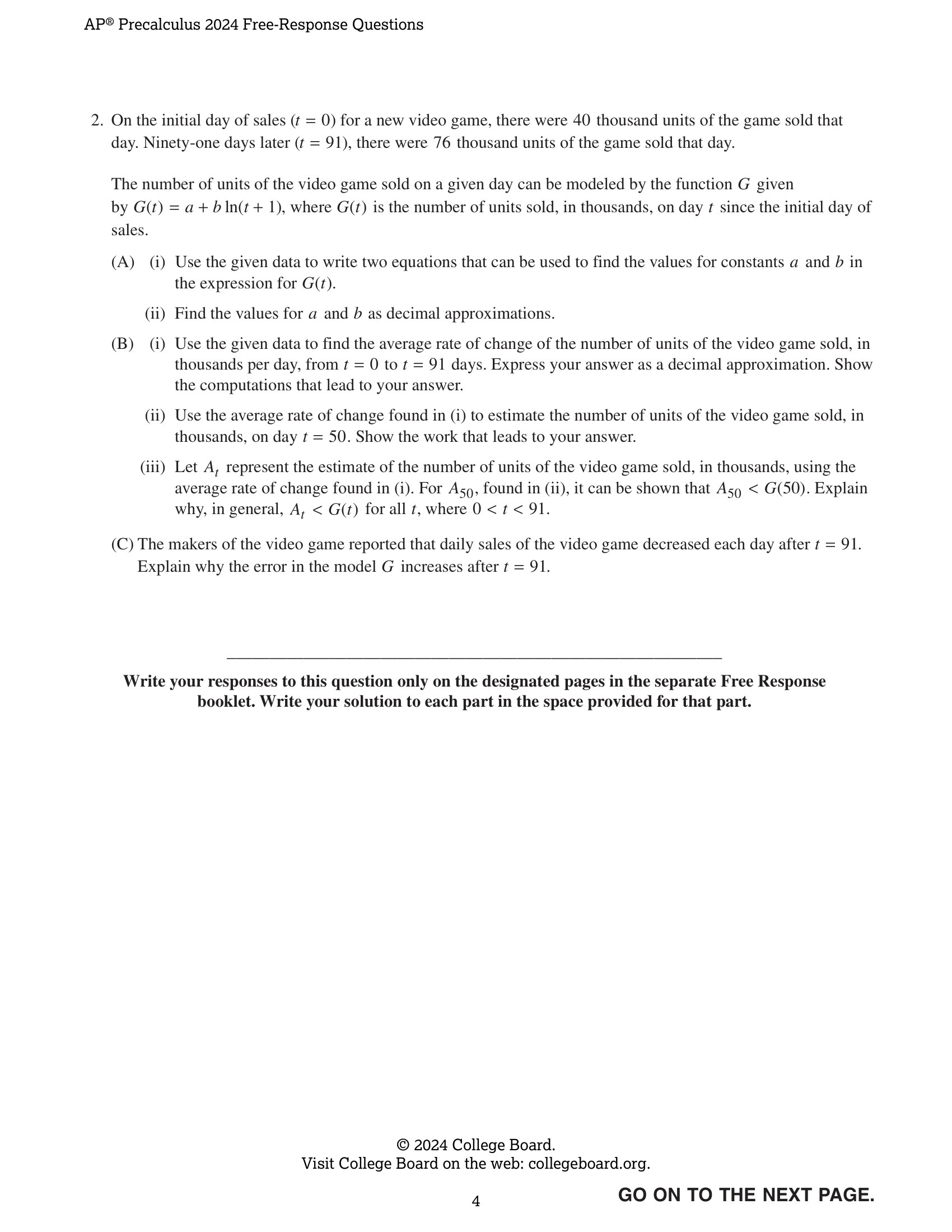
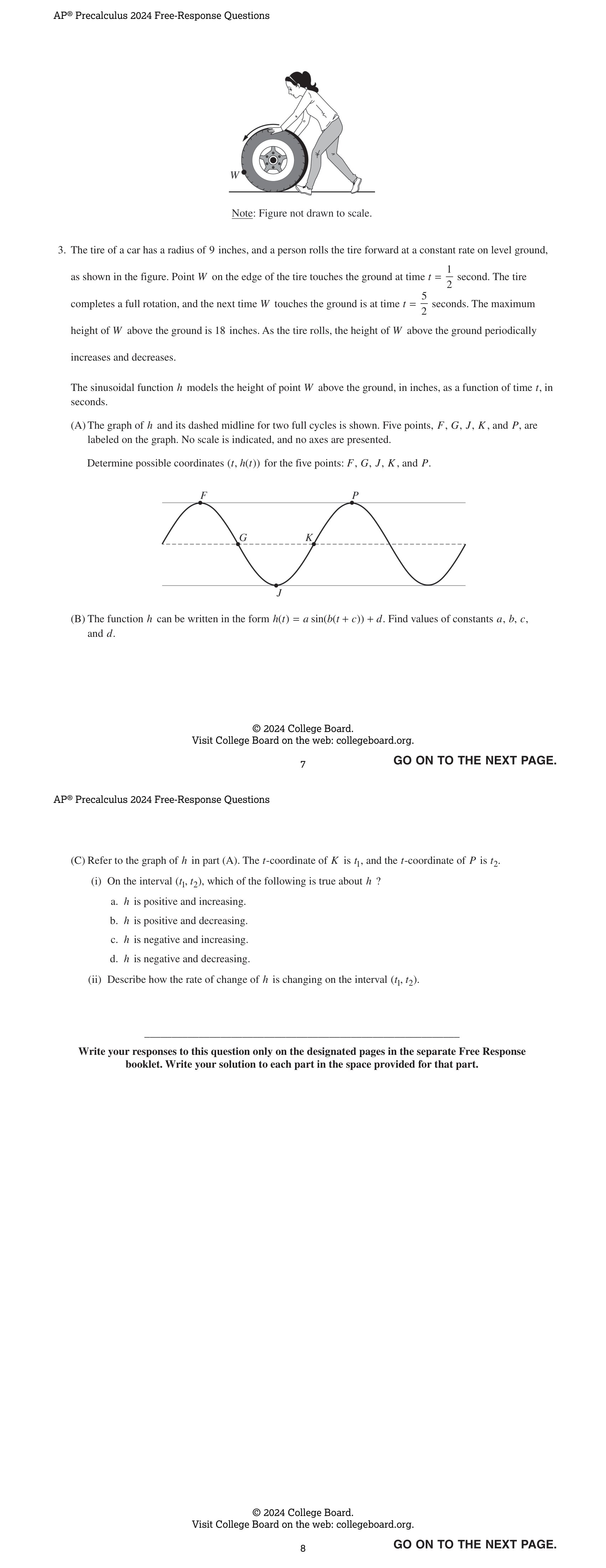
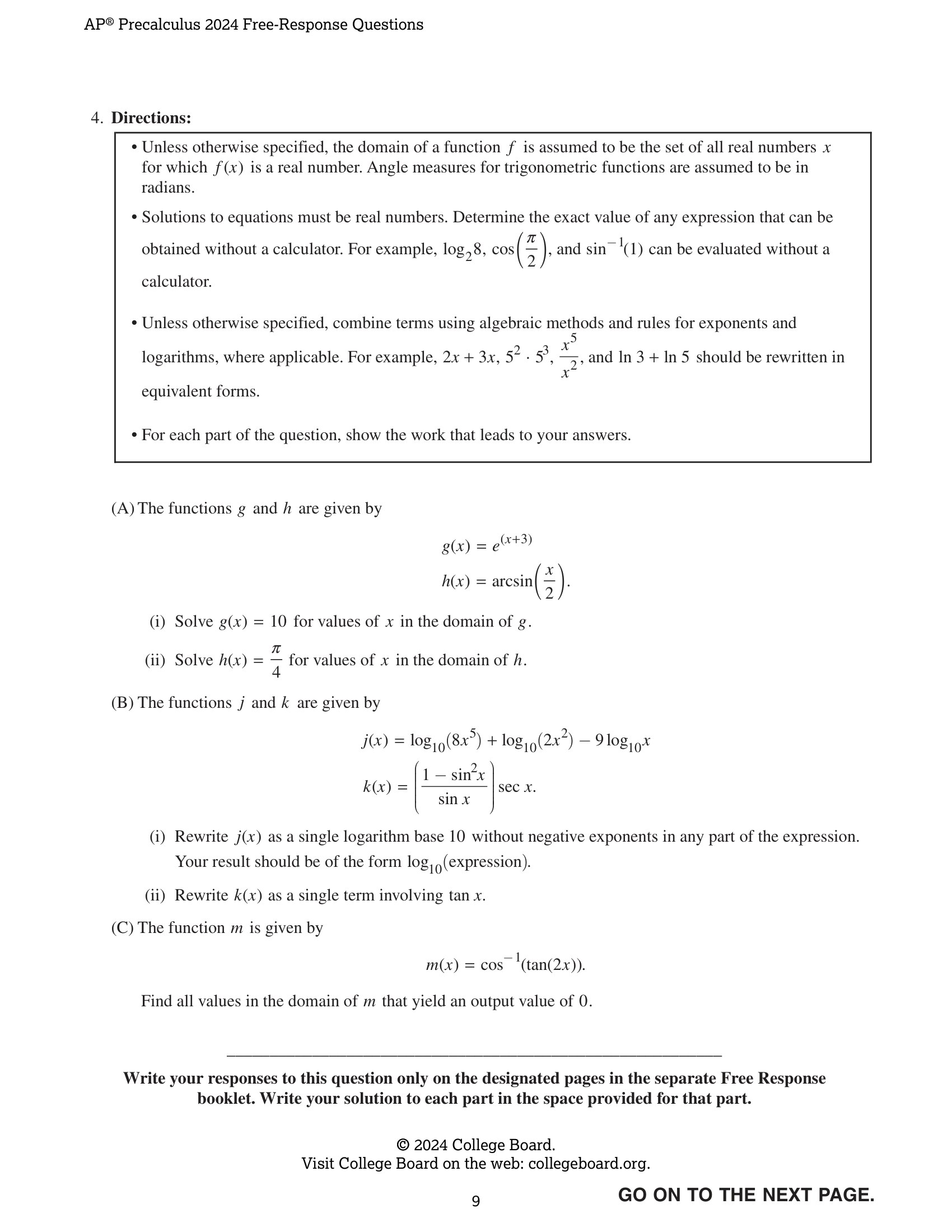
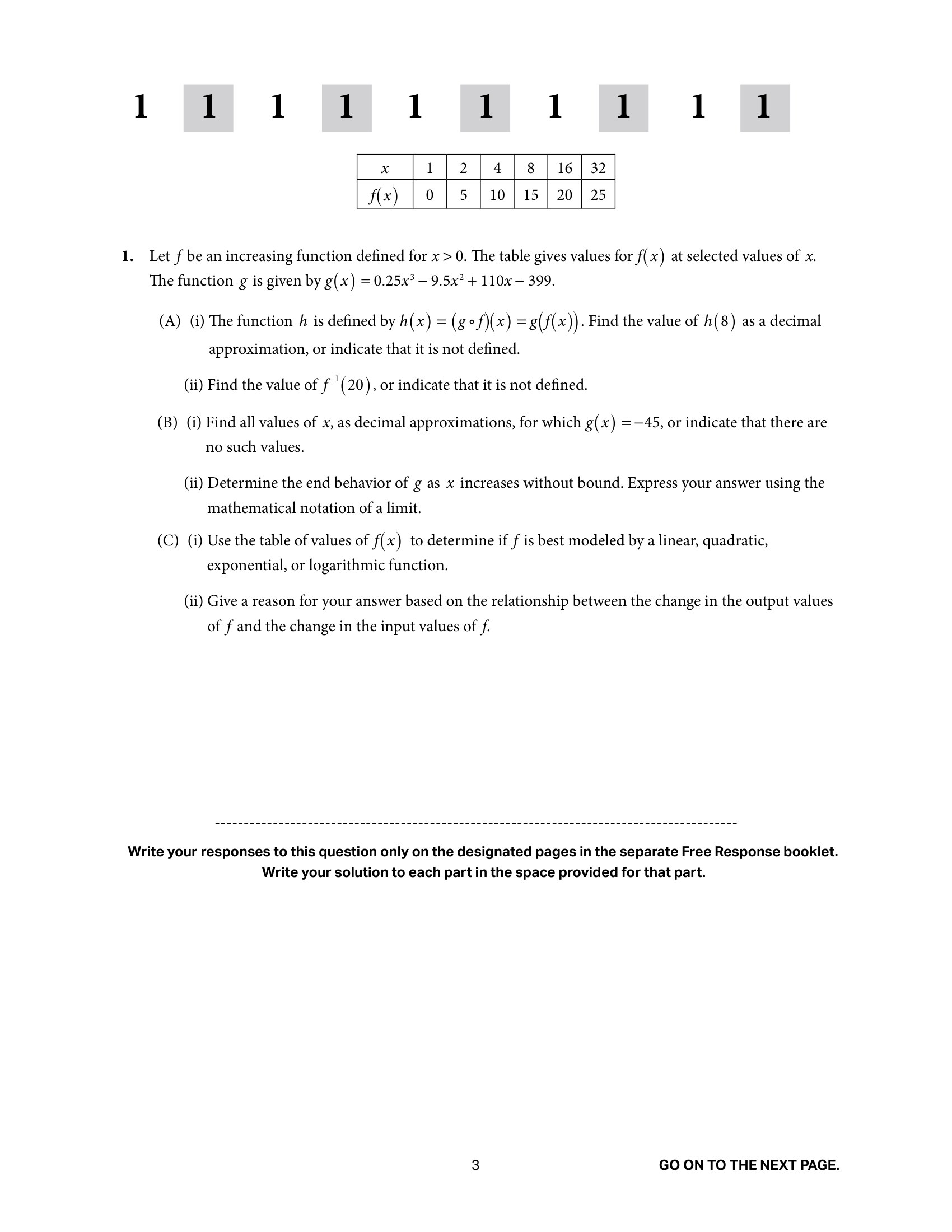
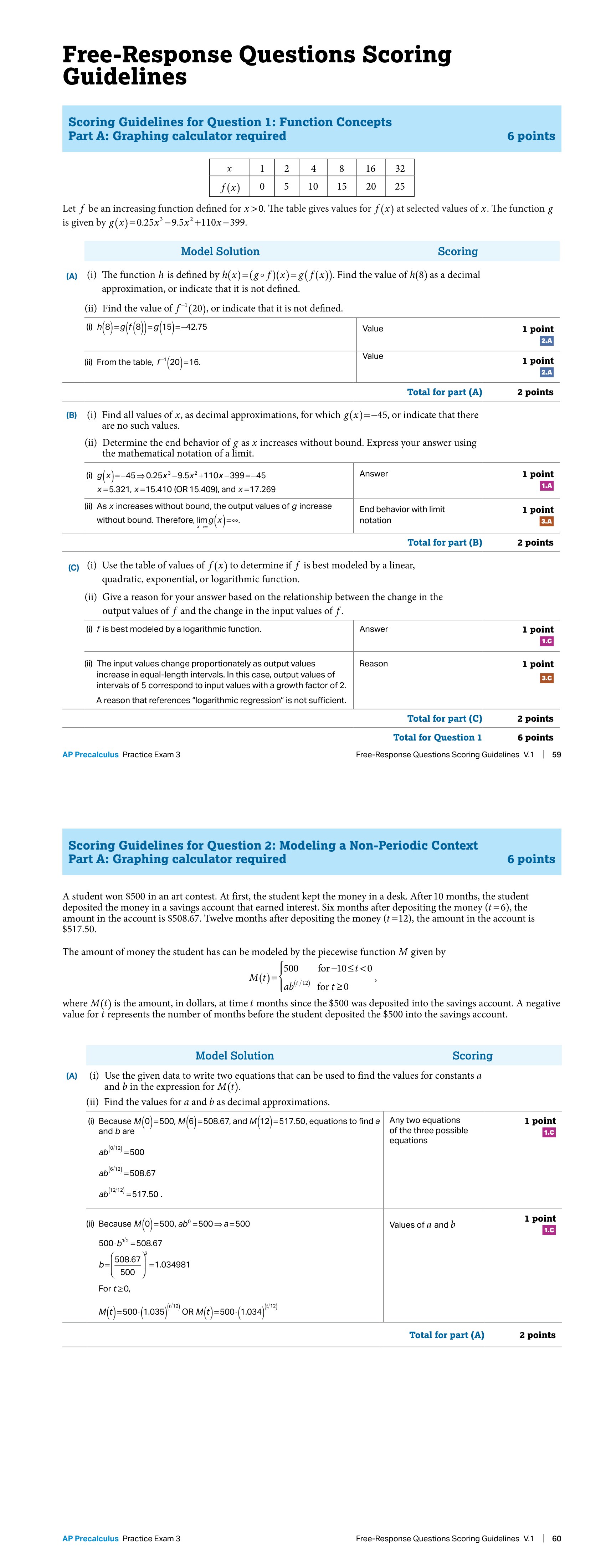
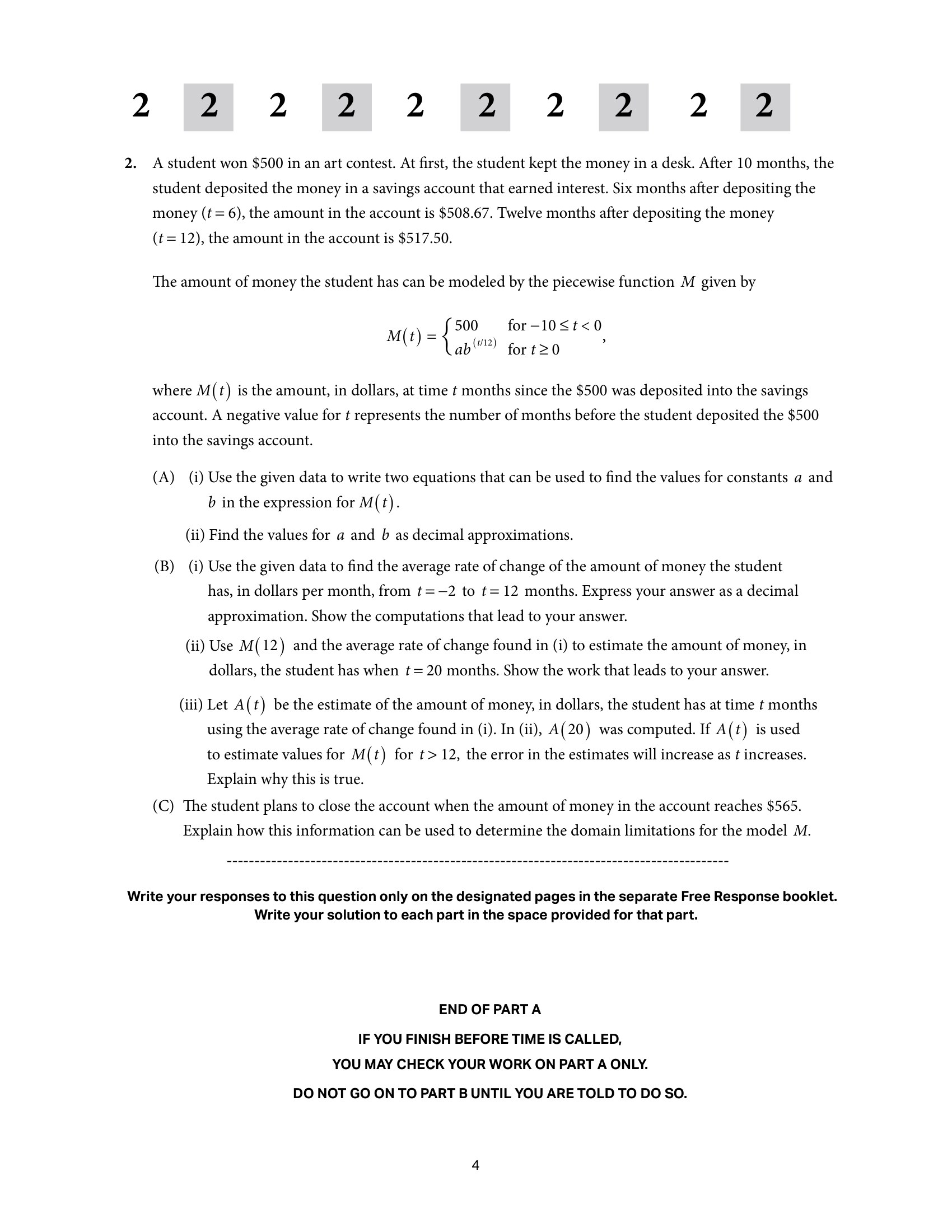
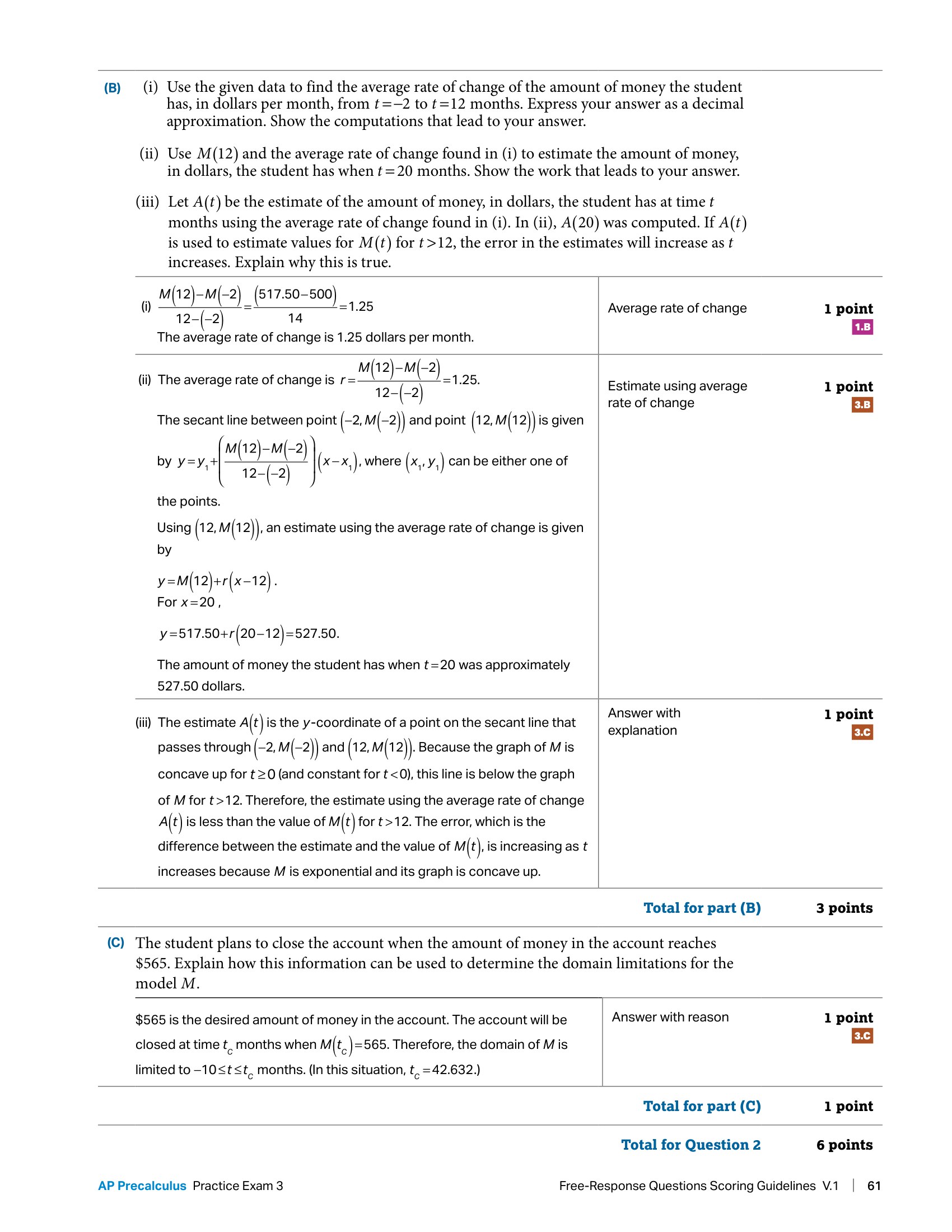
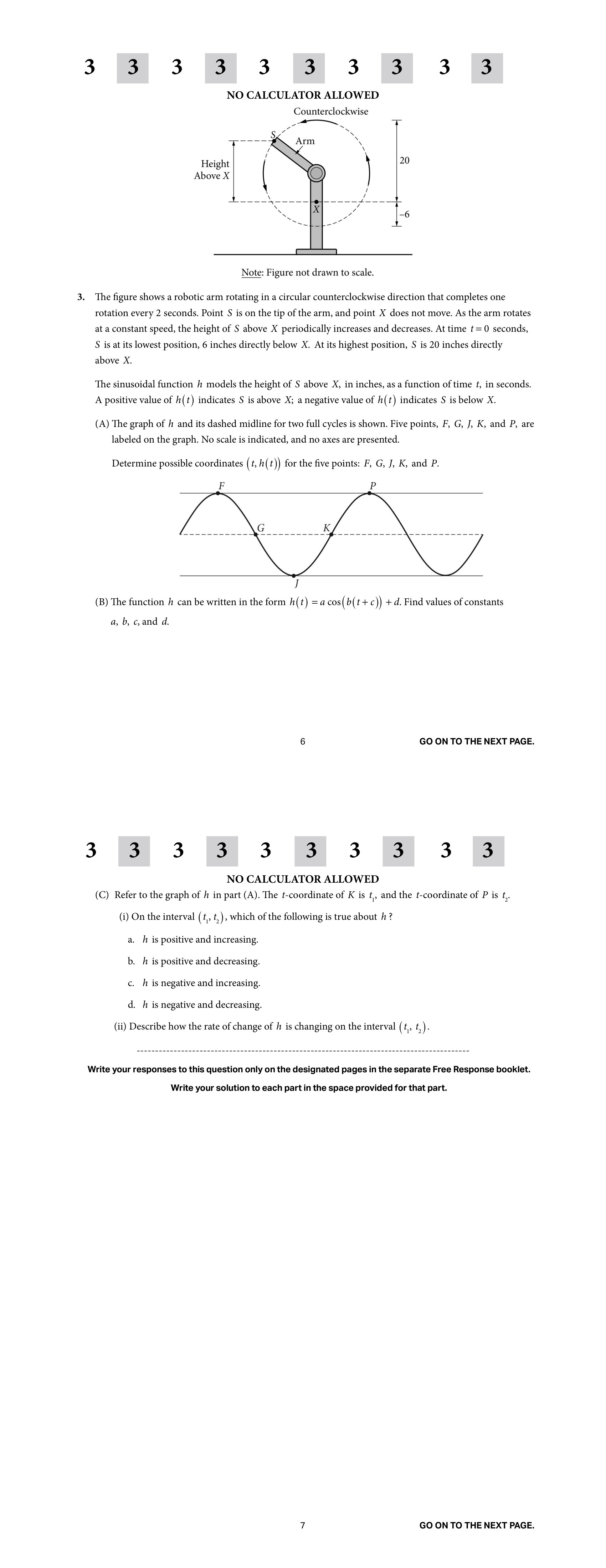
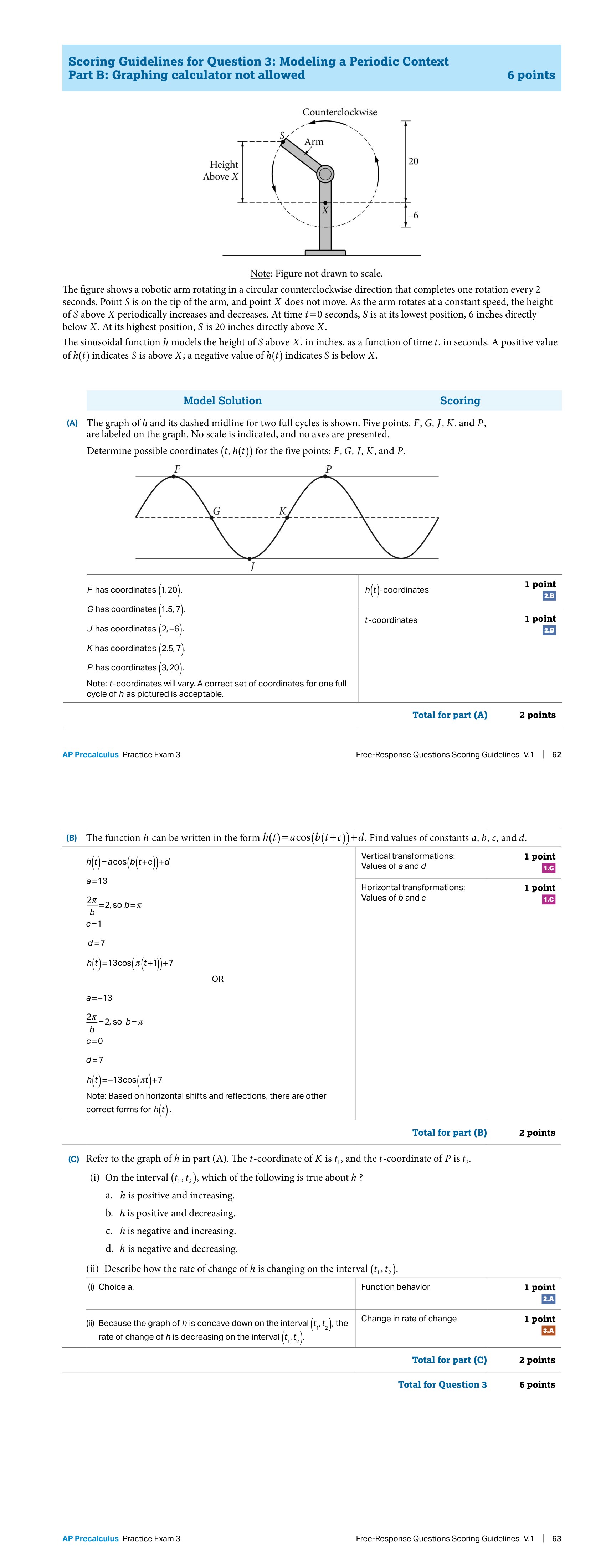
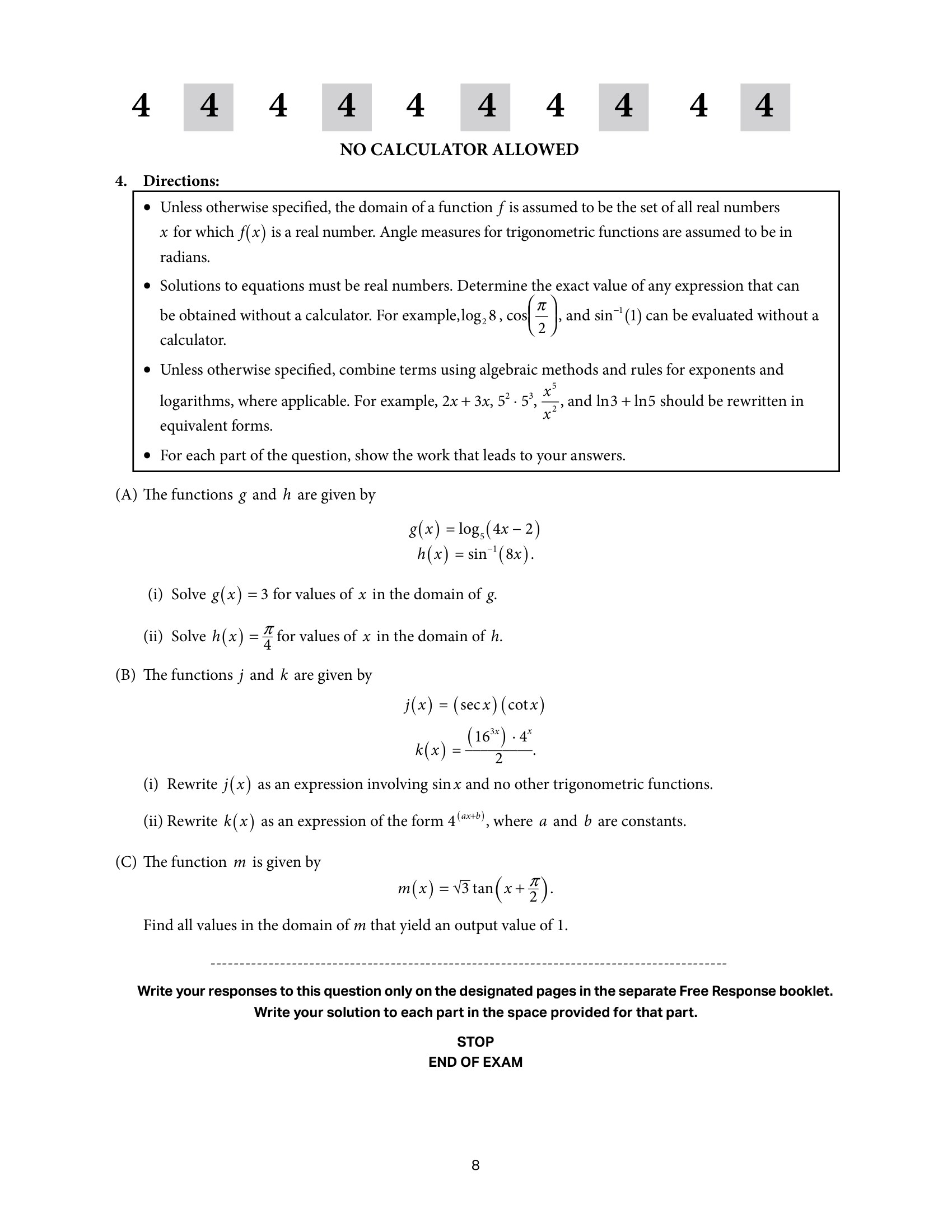
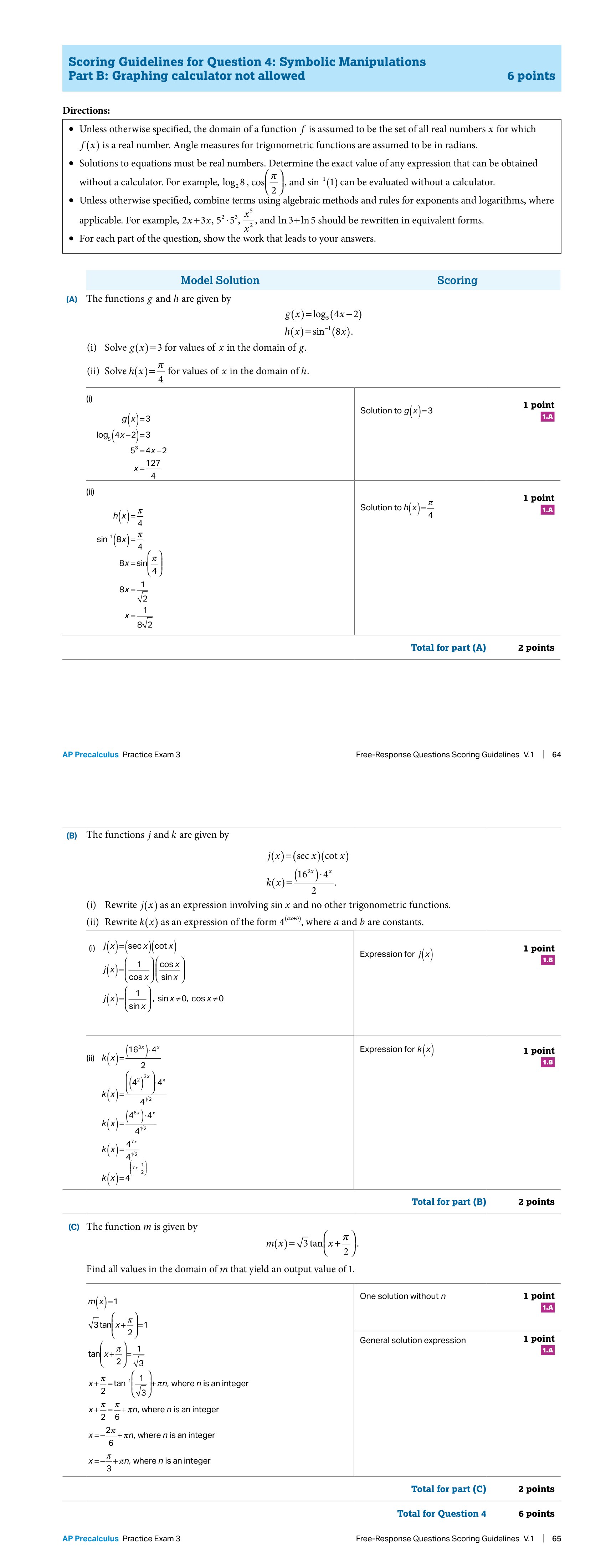
2024 首考的新科目,真题少 — 但这正是 AI 押题最有价值的场景。覆盖 8 道公开真题 FRQ(2024 + 2025 北美) + 40 道 AI 押题 MCQ。New course (first administered 2024). Past papers are scarce — which is exactly where AI prediction shines. Covers 8 official released FRQs (2024 + 2025) + 40 AI-predicted MCQs.
📝 考试格式Exam Format:
Section I · 40 MCQ · 2 小时(Part A 28 无 calc · Part B 12 必 calc)· 占 62.5%Section I · 40 MCQ · 2 h (Part A 28 no-calc · Part B 12 calc) · 62.5%
Section II · 4 FRQ · 1 小时(Part A 2 calc · Part B 2 no calc)· 占 37.5%Section II · 4 FRQ · 1 h (Part A 2 calc · Part B 2 no-calc) · 37.5%
Part III · MCQ 题库(64 题)Part III · MCQ Bank (64 Qs)
40 道 AI 押题 + 24 道 CED 官方样题(50 no-calc · 14 calc)。按单元 / 来源 / 计算器筛选,点击 A–D 即时判分。40 AI-predicted + 24 official CED samples (50 no-calc · 14 calc). Filter by unit / source / calc, then click A–D to grade.
MCQ 题库 — 64 题MCQ Bank — 64 questions
单元Unit
来源Source
Calc
MCQ 1
U1 多项式 / 有理 / U1 Polynomial / Rational
AI 押题AI Pick
A polynomial function \(p\) has the following end behavior:
\[\lim_{x\to-\infty} p(x) = +\infty \quad\text{and}\quad \lim_{x\to+\infty} p(x) = -\infty.\]
Which of the following statements about \(p\) must be true?
(A) \(p\) has even degree and a positive leading coefficient.
(B) \(p\) has odd degree and a negative leading coefficient.
(C) \(p\) has odd degree and a positive leading coefficient.
(D) \(p\) has even degree and a negative leading coefficient.
📖 查看解题思路 / Show solution
Because the two ends of the graph go in opposite directions (up on the left, down on the right), \(p\) must have odd degree. Since \(p(x)\to-\infty\) as \(x\to+\infty\), the leading coefficient is negative. Therefore \(p\) has odd degree with a negative leading coefficient.
MCQ 2
U1 多项式 / 有理 / U1 Polynomial / Rational
AI 押题AI Pick
Let \(p\) be the polynomial defined by \[p(x)=(x^2-9)(x+1)^3(x-2)^2.\] Counting each zero according to its multiplicity, how many real zeros does \(p\) have?
(A) 4
(B) 5
(C) 6
(D) 7
📖 查看解题思路 / Show solution
Factoring \(x^2-9=(x-3)(x+3)\) gives \(p(x)=(x-3)(x+3)(x+1)^3(x-2)^2\). The real zeros are \(x=3\) (multiplicity 1), \(x=-3\) (multiplicity 1), \(x=-1\) (multiplicity 3), and \(x=2\) (multiplicity 2). The total, counted with multiplicity, is \(1+1+3+2=7\).
MCQ 3
U1 多项式 / 有理 / U1 Polynomial / Rational
AI 押题AI Pick
Let \(f(x) = \dfrac{x^2 - x - 6}{x^2 - 4x + 3}\). Which of the following correctly describes the vertical asymptote(s) and removable discontinuity (hole) of the graph of \(f\)?
(A) Vertical asymptotes at \(x = 1\) and \(x = 3\); no removable discontinuity.
(B) Vertical asymptote at \(x = 3\); removable discontinuity at \(x = 1\).
(C) Vertical asymptote at \(x = 1\); removable discontinuity at \(x = 3\).
(D) Vertical asymptotes at \(x = 1\) and \(x = 3\); removable discontinuity at \(x = -2\).
📖 查看解题思路 / Show solution
Factor: \(f(x) = \dfrac{(x-3)(x+2)}{(x-1)(x-3)}\). The factor \((x-3)\) cancels, producing a removable discontinuity at \(x=3\). The remaining factor \((x-1)\) in the denominator does not cancel, so \(x=1\) is a vertical asymptote. The value \(x=-2\) is a zero of \(f\), not a hole.
MCQ 4
U1 多项式 / 有理 / U1 Polynomial / Rational
AI 押题AI Pick
Let \(f(x) = \dfrac{2x^3 - 3x^2 + x - 5}{x^2 + 1}\). Which of the following is the equation of the slant (oblique) asymptote of the graph of \(f\)?
(A) \(y = 2x - 3\)
(B) \(y = 2x + 3\)
(C) \(y = 2x\)
(D) \(y = 2x - 1\)
📖 查看解题思路 / Show solution
Because the degree of the numerator is exactly one more than the degree of the denominator, the graph has a slant asymptote given by the polynomial quotient. Performing the division \((2x^3 - 3x^2 + x - 5) \div (x^2 + 1)\): \(2x^3 \div x^2 = 2x\), and \(2x(x^2+1) = 2x^3 + 2x\), leaving \(-3x^2 - x - 5\). Then \(-3x^2 \div x^2 = -3\), and \(-3(x^2+1) = -3x^2 - 3\), leaving remainder \(-x - 2\). The quotient is \(2x - 3\), so the slant asymptote is \(y = 2x - 3\).
MCQ 5
U1 多项式 / 有理 / U1 Polynomial / Rational
AI 押题AI Pick
The polynomial function \(f\) is defined by \(f(x) = x^3 - 6x^2\). The function \(g\) is defined by \(g(x) = \dfrac{1}{2}\,f(x+1)\). Which of the following is an equivalent expression for \(g(x)\)?
(A) \(\dfrac{1}{2}(x-1)^2(x-7)\)
(B) \(\dfrac{1}{2}(x+1)^2(x-5)\)
(C) \(2(x+1)^2(x-5)\)
(D) \(\dfrac{1}{2}(x+1)^2(x-6)\)
📖 查看解题思路 / Show solution
Factor \(f(x) = x^2(x-6)\), so \(f(x+1) = (x+1)^2\big((x+1)-6\big) = (x+1)^2(x-5)\). Multiplying by \(\tfrac{1}{2}\) gives \(g(x) = \tfrac{1}{2}(x+1)^2(x-5)\).
MCQ 6
U1 多项式 / 有理 / U1 Polynomial / Rational
AI 押题AI Pick
Let \(f(x) = x^3 - 2x^2 + 5\). What is the average rate of change of \(f\) on the interval \([-1, 3]\)?
(A) \(3\)
(B) \(6\)
(C) \(-3\)
(D) \(2\)
📖 查看解题思路 / Show solution
Compute \(f(3) = 27 - 18 + 5 = 14\) and \(f(-1) = -1 - 2 + 5 = 2\). The average rate of change is \(\dfrac{f(3) - f(-1)}{3 - (-1)} = \dfrac{14 - 2}{4} = 3\).
MCQ 7
U1 多项式 / 有理 / U1 Polynomial / Rational
AI 押题AI Pick
The polynomial function \(p\) is defined by \(p(x) = (3x+5)(x-2)^3(4-x)\). What is the sum of the distinct real zeros of \(p\)?
(A) \(\dfrac{23}{3}\)
(B) \(-\dfrac{11}{3}\)
(C) \(\dfrac{13}{3}\)
(D) \(\dfrac{25}{3}\)
📖 查看解题思路 / Show solution
Setting each factor equal to zero: \(3x+5=0 \Rightarrow x=-\tfrac{5}{3}\); \((x-2)^3=0 \Rightarrow x=2\); \(4-x=0 \Rightarrow x=4\). The distinct real zeros are \(-\tfrac{5}{3},\,2,\,4\), and their sum is \(-\tfrac{5}{3}+2+4=\tfrac{13}{3}\).
MCQ 8
U1 多项式 / 有理 / U1 Polynomial / Rational
AI 押题AI Pick
What are all real solutions to the equation \[\dfrac{x}{x-2} + \dfrac{3}{x+1} = \dfrac{6}{x^{2}-x-2}\,?\]
(A) \(x = 2\) and \(x = -6\)
(B) \(x = 2\) only
(C) \(x = 6\) only
(D) \(x = -6\) only
📖 查看解题思路 / Show solution
Since \(x^{2}-x-2=(x-2)(x+1)\), multiplying both sides by \((x-2)(x+1)\) gives \(x(x+1)+3(x-2)=6\), which simplifies to \(x^{2}+4x-12=0\), or \((x+6)(x-2)=0\). Thus \(x=-6\) or \(x=2\), but \(x=2\) makes the original denominators zero and is extraneous. The only solution is \(x=-6\).
MCQ 9
U1 多项式 / 有理 / U1 Polynomial / Rational
AI 押题AI Pick
Let \(f\) be the polynomial function defined by \(f(x) = x^3 - 6x^2 + 5\). On which of the following intervals is the graph of \(f\) concave up?
(A) \((2, \infty)\)
(B) \((-\infty, 2)\)
(C) \((4, \infty)\)
(D) \((0, 4)\)
📖 查看解题思路 / Show solution
The graph of \(f\) is concave up on intervals where the rate of change of \(f\) is increasing. Computing successive average rates of change of \(f\) over unit intervals starting at \(x=0\) gives \(-5, -11, -11, -5, 7, 25,\dots\); the second differences are \(-6, 0, 6, 12, 18\), turning positive once \(x>2\). Equivalently, the rate of change \(3x^2-12x\) is itself increasing where \(6x-12>0\), i.e., on \((2,\infty)\).
MCQ 10
U1 多项式 / 有理 / U1 Polynomial / Rational
AI 押题AI Pick
Let \(f\) be the piecewise function defined by \[f(x)=\begin{cases} x^{2}-kx & \text{for } x<-2 \\ kx+12 & \text{for } x\ge -2 \end{cases}\] where \(k\) is a real constant. For what value of \(k\) is \(f\) continuous at \(x=-2\)?
(A) \(k=2\)
(B) \(k=-2\)
(C) \(k=4\)
(D) \(k=8\)
📖 查看解题思路 / Show solution
Continuity at \(x=-2\) requires the two pieces to agree there. From the left: \((-2)^2-k(-2)=4+2k\). From the right: \(k(-2)+12=-2k+12\). Setting \(4+2k=-2k+12\) gives \(4k=8\), so \(k=2\).
MCQ 11
U1 多项式 / 有理 / U1 Polynomial / Rational
AI 押题AI Pick
The polynomial \(p(x)\) has degree 4 and real coefficients. Given that \(2-3i\) and \(-1\) are zeros of \(p(x)\), which of the following must also be a zero of \(p(x)\)?
(A) \(-2+3i\)
(B) \(2+3i\)
(C) \(1\)
(D) \(-2-3i\)
📖 查看解题思路 / Show solution
By the Complex Conjugate Root Theorem, nonreal zeros of a polynomial with real coefficients occur in conjugate pairs. Since \(2-3i\) is a zero, its conjugate \(2+3i\) must also be a zero of \(p(x)\).
MCQ 12
U1 多项式 / 有理 / U1 Polynomial / Rational
AI 押题AI Pick
The height of a young tree, in centimeters, is modeled by the function \(H(t) = -0.3t^3 + 4t^2 + 2t + 50\), where \(t\) is the time in weeks since the tree was planted. What is the average rate of change of the tree's height, in centimeters per week, over the interval from \(t = 2\) to \(t = 6\)?
(A) \(12.267\) centimeters per week
(B) \(-18.400\) centimeters per week
(C) \(18.400\) centimeters per week
(D) \(73.600\) centimeters per week
📖 查看解题思路 / Show solution
Compute \(H(2) = -0.3(8) + 4(4) + 2(2) + 50 = 67.6\) and \(H(6) = -0.3(216) + 4(36) + 2(6) + 50 = 141.2\). The average rate of change is \(\dfrac{H(6) - H(2)}{6 - 2} = \dfrac{141.2 - 67.6}{4} = \dfrac{73.6}{4} = 18.4\) centimeters per week.
MCQ 13
U1 多项式 / 有理 / U1 Polynomial / Rational
AI 押题AI Pick
The table below gives values of a function \(f\) at selected values of \(x\).
\[
\begin{array}{|c|c|}\hline x & f(x) \\\hline 1 & -1.3 \\ 2 & 0.4 \\ 3 & 4.5 \\ 4 & 13.4 \\ 5 & 29.5 \\ 6 & 55.2 \\\hline \end{array}
\]
A cubic regression model of the form \(y = ax^3 + bx^2 + cx + d\) is fit to the data. What is the value of \(a\)?
(A) \(0.4\)
(B) \(-1.2\)
(C) \(2.5\)
(D) \(-3.0\)
📖 查看解题思路 / Show solution
Entering the six data points into a calculator and performing cubic regression returns \(y = 0.4x^3 - 1.2x^2 + 2.5x - 3\). The leading coefficient is \(a = 0.4\). The other choices are the values of \(b\), \(c\), and \(d\), respectively.
MCQ 14
U1 多项式 / 有理 / U1 Polynomial / Rational
AI 押题AI Pick
A bacterial culture is treated with an antibiotic at time \(t = 0\) hours. For \(t \geq 0\), the number of bacteria in the culture, measured in thousands, is modeled by
\[ N(t) = \dfrac{15t + 60}{t + 12}. \]
Based on the model, which of the following is the best interpretation of the long-run behavior of the bacteria population?
(A) The number of bacteria approaches 5,000 as \(t\) increases without bound.
(B) The number of bacteria approaches 15 as \(t\) increases without bound.
(C) The number of bacteria approaches 15,000 as \(t\) increases without bound.
(D) The number of bacteria decreases without bound as \(t\) increases.
📖 查看解题思路 / Show solution
Since \(N(t)\) is a rational function whose numerator and denominator have the same degree, the horizontal asymptote is the ratio of the leading coefficients: \(y = \tfrac{15}{1} = 15\). Because \(N\) is measured in thousands of bacteria, \(N(t) \to 15\) thousand, i.e., 15,000 bacteria, as \(t \to \infty\).
MCQ 15
U1 多项式 / 有理 / U1 Polynomial / Rational
AI 押题AI Pick
The profit, in thousands of dollars, of a small company \(t\) months after launching a new product is modeled by \[P(t)=-0.05t^{3}+0.9t^{2}-2t-5\] for \(0\le t\le 16\). The company "breaks even" when \(P(t)=0\). To the nearest thousandth, what is the largest value of \(t\) at which the company breaks even during this time interval?
(A) \(t\approx 4.612\)
(B) \(t\approx 10.760\)
(C) \(t\approx 11.250\)
(D) \(t\approx 14.854\)
📖 查看解题思路 / Show solution
Using a graphing/numerical solver on \(P(t)=-0.05t^{3}+0.9t^{2}-2t-5=0\) over \([0,16]\) gives two real zeros, approximately \(t\approx 4.612\) and \(t\approx 14.854\). The largest zero in the interval is \(t\approx 14.854\). (Choice A is the smaller zero; choice B is the time of maximum profit found from \(P'(t)=0\); choice C is the maximum profit value, not a zero.)
MCQ 16
U1 多项式 / 有理 / U1 Polynomial / Rational
AI 押题AI Pick
The graph of the polynomial function \(p\) has \(x\)-intercepts at \(x = -2\), \(x = 1\), and \(x = 4\), each of multiplicity 1. The graph passes through the point \((0, 8)\), and the end behavior of \(p\) is given by \(\displaystyle \lim_{x \to -\infty} p(x) = -\infty\) and \(\displaystyle \lim_{x \to \infty} p(x) = \infty\). Which of the following is the solution set to the inequality \(p(x) \le 0\)?
(A) \((-\infty, -2) \cup (1, 4)\)
(B) \((-\infty, -2] \cup [1, 4]\)
(C) \([-2, 1] \cup [4, \infty)\)
(D) \((-\infty, -2] \cup [4, \infty)\)
📖 查看解题思路 / Show solution
Because \(p\) is a cubic with positive leading coefficient (from the end behavior) and simple roots at \(-2, 1, 4\), the sign of \(p(x)\) alternates: negative on \((-\infty,-2)\), positive on \((-2,1)\), negative on \((1,4)\), and positive on \((4,\infty)\). Including the zeros (since the inequality is non-strict), \(p(x)\le 0\) on \((-\infty,-2] \cup [1,4]\).
MCQ 17
U1 多项式 / 有理 / U1 Polynomial / Rational
CED 样题CED Sample
The polynomial function \(p\) is given by \(p(x) = -4x^3 + 3x^2 + 1\). Which of the following statements about the end behavior of \(p\) is true?
(A) The sign of the leading term of \(p\) is positive, and the degree of the leading term of \(p\) is even; therefore, \(\lim_{x \to -\infty} p(x) = \infty\) and \(\lim_{x \to \infty} p(x) = \infty\).
(B) The sign of the leading term of \(p\) is negative, and the degree of the leading term of \(p\) is odd; therefore, \(\lim_{x \to -\infty} p(x) = \infty\) and \(\lim_{x \to \infty} p(x) = -\infty\).
(C) The sign of the leading term of \(p\) is positive, and the degree of the leading term of \(p\) is odd; therefore, \(\lim_{x \to -\infty} p(x) = -\infty\) and \(\lim_{x \to \infty} p(x) = \infty\).
(D) The sign of the leading term of \(p\) is negative, and the degree of the leading term of \(p\) is odd; therefore, \(\lim_{x \to -\infty} p(x) = -\infty\) and \(\lim_{x \to \infty} p(x) = \infty\).
MCQ 18
U1 多项式 / 有理 / U1 Polynomial / Rational
CED 样题CED Sample
The depth of water, in feet, at a certain place in a lake is modeled by a function \(W\). The graph of \(y = W(t)\) is shown for \(0 \leq t \leq 30\), where \(t\) is the number of days since the first day of a month. What are all intervals of \(t\) on which the depth of water is increasing at a decreasing rate?
(A) \((3, 6)\) only
(B) \((3, 12)\)
(C) \((0, 3)\) and \((18, 30)\) only
(D) \((0, 6)\) and \((18, 30)\)
MCQ 19
U1 多项式 / 有理 / U1 Polynomial / Rational
CED 样题CED Sample
Which of the following functions has a zero at \(x = 3\) and has a graph in the \(xy\)-plane with a vertical asymptote at \(x = 2\) and a hole at \(x = 1\)?
(A) \(h(x) = \dfrac{x^2 - 4x + 3}{x^2 - 3x + 2}\)
(B) \(j(x) = \dfrac{x^2 - 5x + 6}{x^2 - 3x + 2}\)
(C) \(k(x) = \dfrac{x - 3}{x^2 - 3x + 2}\)
(D) \(m(x) = \dfrac{x - 3}{x^2 - 4x + 3}\)
MCQ 20
U1 多项式 / 有理 / U1 Polynomial / Rational
CED 样题CED Sample
The polynomial function \(p\) is an odd function. If \(p(3) = -4\) is a relative maximum of \(p\), which of the following statements about \(p(-3)\) must be true?
(A) \(p(-3) = 4\) is a relative maximum.
(B) \(p(-3) = -4\) is a relative maximum.
(C) \(p(-3) = 4\) is a relative minimum.
(D) \(p(-3) = -4\) is a relative minimum.
MCQ 21
U1 多项式 / 有理 / U1 Polynomial / Rational
CED 样题CED Sample
The function \(g\) is given by \(g(x) = x^3 - 3x^2 - 18x\), and the function \(h\) is given by \(h(x) = x^2 - 2x - 35\). Let \(k\) be the function given by \(k(x) = \dfrac{h(x)}{g(x)}\). What is the domain of \(k\)?
(A) all real numbers \(x\) where \(x \neq 0\)
(B) all real numbers \(x\) where \(x \neq -5, x \neq 7\)
(C) all real numbers \(x\) where \(x \neq -3, x \neq 0, x \neq 6\)
(D) all real numbers \(x\) where \(x \neq -5, x \neq -3, x \neq 0, x \neq 6, x \neq 7\)
MCQ 22
U1 多项式 / 有理 / U1 Polynomial / Rational
CED 样题CED Sample
The figure shown is the graph of a polynomial function \(g\). Which of the following could be an expression for \(g(x)\)?
(A) \(0.25(x - 5)(x - 1)(x + 8)\)
(B) \(0.25(x + 5)(x + 1)(x - 8)\)
(C) \(0.25(x - 5)^2(x - 1)(x + 8)\)
(D) \(0.25(x + 5)^2(x + 1)(x - 8)\)
MCQ 23
U1 多项式 / 有理 / U1 Polynomial / Rational
CED 样题CED Sample
The table gives values for a polynomial function \(f\) at selected values of \(x\). Let \(g(x) = af(bx) + c\), where \(a\), \(b\), and \(c\) are positive constants. In the \(xy\)-plane, the graph of \(g\) is constructed by applying three transformations to the graph of \(f\) in this order: a horizontal dilation by a factor of \(2\), a vertical dilation by a factor of \(3\), and a vertical translation by \(5\) units. What is the value of \(g(-4)\)?
\(x\)
\(-8\)
\(-4\)
\(-2\)
\(-1\)
\(0\)
\(3\)
\(f(x)\)
\(87\)
\(55\)
\(5\)
\(-4\)
\(-7\)
\(20\)
(A) \(266\)
(B) \(170\)
(C) \(28\)
(D) \(20\)
MCQ 24
U1 多项式 / 有理 / U1 Polynomial / Rational
CED 样题CED Sample
A food vendor developed a new sandwich type for sale. The vendor made estimates about the sales of the new sandwich type over time. A linear regression was used to develop a model for the sales over time. The figure shows a graph of the residuals of the linear regression. Which of the following statements about the linear regression is true?
📊 Residuals plot showing points scattered around \(y = 0\) with a curved pattern, with residuals ranging from approximately \(-20\) to \(20\) over time.
(A) The linear model is not appropriate, because there is a clear pattern in the graph of the residuals.
(B) The linear model is not appropriate, because the graph of the residuals has more points above \(0\) than below \(0\).
(C) The linear model is appropriate, because there is a clear pattern in the graph of the residuals.
(D) The linear model is appropriate, because the positive residual farthest from \(0\) and the negative residual farthest from \(0\) are about the same distance, although more points are above than below \(0\).
MCQ 25
U1 多项式 / 有理 / U1 Polynomial / Rational
CED 样题CED Sample
The temperature, in degrees Celsius (°C), in a city on a particular day is modeled by the function \(T\) defined by \(T(t) = \dfrac{75t^3 - 836t^2 + 3100t - 4185}{14t^2 + 10t - 35}\), where \(t\) is measured in hours from 12 P.M. for \(2 \le t \le 9\). Based on the model, how many hours did it take for the temperature to increase from \(0°C\) to \(5°C\)?
(A) 7.701
(B) 5.420
(C) 4.114
(D) 2.280
MCQ 26
U2 指数 / 对数 / U2 Exponential / Logarithmic
AI 押题AI Pick
The expression \(\left(3^{2x+1}\right)^{2} \cdot 3^{\,x-3}\) is equivalent to which of the following?
(A) \(3^{5x-1}\)
(B) \(3^{3x-1}\)
(C) \(3^{\,4x^{2}-10x-6}\)
(D) \(9^{5x-1}\)
📖 查看解题思路 / Show solution
Apply the power rule: \(\left(3^{2x+1}\right)^{2}=3^{2(2x+1)}=3^{4x+2}\). Then use the product rule: \(3^{4x+2}\cdot 3^{x-3}=3^{(4x+2)+(x-3)}=3^{5x-1}\).
MCQ 27
U2 指数 / 对数 / U2 Exponential / Logarithmic
AI 押题AI Pick
Which of the following is equivalent to \(\log_b\left(\dfrac{x^{3}\sqrt{y}}{z^{2}}\right)\), where \(x>0\), \(y>0\), and \(z>0\)?
(A) \(3\log_b x + \dfrac{1}{2}\log_b y + 2\log_b z\)
(B) \(\dfrac{3\log_b x + \frac{1}{2}\log_b y}{2\log_b z}\)
(D) \(3\log_b x + \dfrac{1}{2}\log_b y - 2\log_b z\)
📖 查看解题思路 / Show solution
Apply the quotient property: \(\log_b\left(\dfrac{x^{3}\sqrt{y}}{z^{2}}\right)=\log_b(x^{3}\sqrt{y})-\log_b(z^{2})\). Then the product property gives \(\log_b(x^{3})+\log_b(y^{1/2})-\log_b(z^{2})\), and the power property yields \(3\log_b x+\tfrac{1}{2}\log_b y-2\log_b z\).
MCQ 28
U2 指数 / 对数 / U2 Exponential / Logarithmic
AI 押题AI Pick
What is the solution to the equation \(\log_2(x+1) + \log_2(x-1) = 3\)?
(A) \(x = 4\)
(B) \(x = -3\)
(C) \(x = 3\)
(D) \(x = \pm 3\)
📖 查看解题思路 / Show solution
Combine the logs: \(\log_2[(x+1)(x-1)] = 3\), so \((x+1)(x-1) = 2^3\), giving \(x^2 - 1 = 8\) and \(x^2 = 9\). The candidates are \(x = \pm 3\), but the original equation requires \(x - 1 > 0\), so \(x = -3\) is extraneous. The only valid solution is \(x = 3\).
MCQ 29
U2 指数 / 对数 / U2 Exponential / Logarithmic
AI 押题AI Pick
Let \(f(x) = 3^{\,x-2} + 5\). Which of the following is an expression for \(f^{-1}(x)\)?
(A) \(f^{-1}(x) = \log_{3}(x-5) + 2\)
(B) \(f^{-1}(x) = \log_{3}(x+5) + 2\)
(C) \(f^{-1}(x) = \log_{3}(x-5) - 2\)
(D) \(f^{-1}(x) = \log_{3}(x-2) + 5\)
📖 查看解题思路 / Show solution
Set \(y = 3^{\,x-2} + 5\) and solve for \(x\): \(y - 5 = 3^{\,x-2}\), so \(\log_{3}(y-5) = x - 2\), giving \(x = \log_{3}(y-5) + 2\). Swapping variables yields \(f^{-1}(x) = \log_{3}(x-5) + 2\).
MCQ 30
U2 指数 / 对数 / U2 Exponential / Logarithmic
AI 押题AI Pick
Let \(f(x) = 2^x\) and \(g(x) = \log_{2}(x - 1) + 3\). Which of the following is an expression for \((f \circ g)(x)\) on the domain \(x > 1\)?
(A) \(x + 7\)
(B) \((x-1)^{3}\)
(C) \(8x - 8\)
(D) \(8x + 8\)
📖 查看解题思路 / Show solution
We have \((f\circ g)(x) = 2^{\log_{2}(x-1) + 3} = 2^{\log_{2}(x-1)} \cdot 2^{3} = (x-1)\cdot 8 = 8x - 8\). Choice A reflects converting the sum in the exponent to a sum of powers, choice B reflects converting the sum in the exponent to a product, and choice D reflects a sign error on \(-1\).
MCQ 31
U2 指数 / 对数 / U2 Exponential / Logarithmic
AI 押题AI Pick
An exponential function \(f\) is defined by \(f(x)=ab^{x}\), where \(a\) and \(b\) are positive constants. If \(f(1)=6\) and \(f(4)=162\), which of the following is an expression for \(f(x)\)?
(A) \(\dfrac{2}{9}\cdot 27^{x}\)
(B) \(6\cdot 3^{x}\)
(C) \(2\cdot 3^{x-1}\)
(D) \(2\cdot 3^{x}\)
📖 查看解题思路 / Show solution
Form the ratio \(\dfrac{f(4)}{f(1)}=\dfrac{ab^{4}}{ab}=b^{3}=\dfrac{162}{6}=27\), so \(b=3\). Then \(ab=6\) gives \(a=2\). Therefore \(f(x)=2\cdot 3^{x}\).
MCQ 32
U2 指数 / 对数 / U2 Exponential / Logarithmic
AI 押题AI Pick
Which of the following is equivalent to \(\left(\log_{3} 8\right)\left(\log_{2} 9\right)\)?
(A) \(\log_{6} 72\)
(B) \(5\)
(C) \(6\)
(D) \(12\)
📖 查看解题思路 / Show solution
Apply the power rule: \(\log_{3} 8 = 3\log_{3} 2\) and \(\log_{2} 9 = 2\log_{2} 3\). Then \(\left(3\log_{3} 2\right)\left(2\log_{2} 3\right) = 6\,(\log_{3} 2)(\log_{2} 3)\). Since \((\log_{3} 2)(\log_{2} 3) = 1\) by the change-of-base identity, the product equals \(6\).
MCQ 33
U2 指数 / 对数 / U2 Exponential / Logarithmic
AI 押题AI Pick
The table below shows values of a function \(f\) believed to be exponential.
\[\begin{array}{|c|c|}\hline x & f(x) \\\hline 0 & 24 \\ 1 & 36 \\ 2 & 54 \\ 3 & 81 \\\hline\end{array}\]
Assuming \(f\) is exponential, what is the predicted value of \(f(6)\), rounded to the nearest thousandth?
(A) 96.000
(B) 216.000
(C) 273.375
(D) 410.063
📖 查看解题思路 / Show solution
The common ratio is \(\dfrac{36}{24}=\dfrac{54}{36}=\dfrac{81}{54}=1.5\), and the initial value is \(f(0)=24\), so \(f(x)=24(1.5)^x\). Then \(f(6)=24(1.5)^6=24(11.390625)=273.375\).
MCQ 34
U2 指数 / 对数 / U2 Exponential / Logarithmic
AI 押题AI Pick
An investment of \$5{,}000 is deposited into an account that earns an annual interest rate of \(4.5\%\) compounded continuously. To the nearest tenth of a year, how long will it take for the value of the investment to triple?
(A) \(24.4\) years
(B) \(15.4\) years
(C) \(10.6\) years
(D) \(2.4\) years
📖 查看解题思路 / Show solution
Using \(A = Pe^{rt}\) with \(A/P = 3\) and \(r = 0.045\), solve \(3 = e^{0.045 t}\). Then \(t = \dfrac{\ln 3}{0.045} \approx \dfrac{1.0986}{0.045} \approx 24.4\) years. Distractor (C) uses \(\log_{10}\) instead of \(\ln\); (B) solves for doubling; (D) misplaces the decimal in \(r\).
MCQ 35
U2 指数 / 对数 / U2 Exponential / Logarithmic
AI 押题AI Pick
A scientist plots a data set as the points \((x, \log_{10} y)\) on a coordinate grid (a semi-log plot). The plotted points lie on a line that passes through \((0, 1)\) and \((4, 3)\). Which of the following functions best models \(y\) as a function of \(x\)?
(A) \(y = 0.5x + 10\)
(B) \(y = 10 \cdot 10^{-0.5x}\)
(C) \(y = 10 \cdot 10^{0.5x}\)
(D) \(y = 10^{0.5x}\)
📖 查看解题思路 / Show solution
Since \((x, \log_{10} y)\) is linear, the line has slope \(\dfrac{3-1}{4-0} = 0.5\) and \(y\)-intercept \(1\), so \(\log_{10} y = 0.5x + 1\). Exponentiating gives \(y = 10^{0.5x+1} = 10^{1} \cdot 10^{0.5x} = 10 \cdot 10^{0.5x}\). Linearity on a semi-log plot indicates an exponential relationship.
MCQ 36
U2 指数 / 对数 / U2 Exponential / Logarithmic
AI 押题AI Pick
A radioactive isotope decays exponentially. A laboratory sample initially has a mass of 80 milligrams, and after 12 years the sample has a mass of 50 milligrams. Based on this model, what is the half-life of the isotope, to the nearest hundredth of a year?
(A) \(8.14\) years
(B) \(12.00\) years
(C) \(16.00\) years
(D) \(17.70\) years
📖 查看解题思路 / Show solution
Model the mass as \(M(t)=80\left(\tfrac{1}{2}\right)^{t/h}\), where \(h\) is the half-life. Setting \(M(12)=50\) gives \(\left(\tfrac{1}{2}\right)^{12/h}=\tfrac{50}{80}=\tfrac{5}{8}\). Solving, \(h=\dfrac{12\ln(1/2)}{\ln(5/8)}\approx 17.70\) years.
MCQ 37
U2 指数 / 对数 / U2 Exponential / Logarithmic
CED 样题CED Sample
Let \(k\), \(w\), and \(z\) be positive constants. Which of the following is equivalent to \(\log_{10}\left(\dfrac{kz}{w^2}\right)\)?
(A) \(\log_{10}(k + z) - \log_{10}(2w)\)
(B) \(\log_{10} k + \log_{10} z - 2\log_{10} w\)
(C) \(\log_{10} k + \log_{10} z - \dfrac{1}{2}\log_{10} w\)
(D) \(\log_{10} k - \log_{10} z + 2\log_{10} w\)
MCQ 38
U2 指数 / 对数 / U2 Exponential / Logarithmic
CED 样题CED Sample
Values of the terms of a geometric sequence \(g_n\) are graphed in the figure. Which of the following is an expression for the \(nth\) term of the geometric sequence?
(A) \(g_n = 4\left(\dfrac{1}{2}\right)^{(n-2)}\)
(B) \(g_n = 8(2)^{(n-1)}\)
(C) \(g_n = 8\left(\dfrac{1}{2}\right)^n\)
(D) \(g_n = 16\left(\dfrac{1}{2}\right)^{(n-1)}\)
MCQ 39
U2 指数 / 对数 / U2 Exponential / Logarithmic
CED 样题CED Sample
The table gives values of the function \(g\) for selected values of \(x\). The function \(f\) is given by \(f(x) = 3^x + x^2\). What is the value of \(f(g(3))\)?
\(x\)
\(g(x)\)
\(-2\)
\(4\)
\(0\)
\(\dfrac{1}{2}\)
\(3\)
\(-2\)
\(4\)
\(3\)
\(36\)
\(9\)
(A) \(-72\)
(B) \(\dfrac{37}{9}\)
(C) \(9\)
(D) \(97\)
MCQ 40
U2 指数 / 对数 / U2 Exponential / Logarithmic
CED 样题CED Sample
The value, in millions of dollars, of transactions processed by an online payment platform is modeled by the function \(M\). The value is expected to increase by \(6.1\%\) each quarter of a year. At time \(t = 0\) years, 54 million dollars of transactions were processed. If \(t\) is measured in years, which of the following is an expression for \(M(t)\)? (Note: A quarter is one fourth of a year.)
(A) \(54(0.061)^{(t/4)}\)
(B) \(54(0.061)^{(4t)}\)
(C) \(54(1.061)^{(t/4)}\)
(D) \(54(1.061)^{(4t)}\)
MCQ 41
U2 指数 / 对数 / U2 Exponential / Logarithmic
CED 样题CED Sample
Iodine-131 has a half-life of 8 days. In a particular sample, the amount of iodine-131 remaining after \(d\) days can be modeled by the function \(h\) given by \(h(d) = A_0(0.5)^{(d/8)}\), where \(A_0\) is the amount of iodine-131 in the sample at time \(d = 0\). Which of the following functions \(k\) models the amount of iodine-131 remaining after \(t\) hours, where \(A_0\) is the amount of iodine-131 in the sample at time \(t = 0\)? (There are 24 hours in a day, so \(t = 24d\).)
What are all values of \(x\) for which \(\ln\left(x^3\right) - \ln x = 4\)?
(A) \(x = -2\) and \(x = 2\)
(B) \(x = -e^2\) and \(x = e^2\)
(C) \(x = e^2\) only
(D) \(x = e^4\)
MCQ 43
U2 指数 / 对数 / U2 Exponential / Logarithmic
CED 样题CED Sample
The table presents values for a function \(f\) at selected values of \(x\). An exponential regression \(y = ab^x\) is used to model these data. What is the value of \(f(1.5)\) predicted by the exponential function model?
\(x\)
\(f(x)\)
\(-2\)
10
\(-1\)
15
1
40
2
56
(A) 46.767
(B) 47.342
(C) 47.800
(D) 47.917
MCQ 44
U3 三角 / 极坐标 / U3 Trigonometric / Polar
AI 押题AI Pick
What is the exact value of \(\cos\left(\dfrac{2\pi}{3}\right) + \sin\left(\dfrac{7\pi}{4}\right)\)?
(A) \(\dfrac{\sqrt{2}-1}{2}\)
(B) \(-\dfrac{1+\sqrt{2}}{2}\)
(C) \(\dfrac{1-\sqrt{2}}{2}\)
(D) \(\dfrac{1+\sqrt{2}}{2}\)
📖 查看解题思路 / Show solution
The angle \(\tfrac{2\pi}{3}\) lies in Quadrant II with reference angle \(\tfrac{\pi}{3}\), so \(\cos(\tfrac{2\pi}{3}) = -\tfrac{1}{2}\). The angle \(\tfrac{7\pi}{4}\) lies in Quadrant IV with reference angle \(\tfrac{\pi}{4}\), so \(\sin(\tfrac{7\pi}{4}) = -\tfrac{\sqrt{2}}{2}\). Adding gives \(-\tfrac{1}{2} - \tfrac{\sqrt{2}}{2} = -\tfrac{1+\sqrt{2}}{2}\).
MCQ 45
U3 三角 / 极坐标 / U3 Trigonometric / Polar
AI 押题AI Pick
The function \(f\) is defined by \(f(x) = -3\cos\!\left(\dfrac{\pi}{2}x - \pi\right) + 4\). Which of the following correctly identifies the amplitude, period, and midline of the graph of \(f\)?
(A) Amplitude \(-3\), period \(\dfrac{\pi}{2}\), midline \(y = 4\)
(B) Amplitude \(3\), period \(\dfrac{\pi}{2}\), midline \(y = 4\)
(C) Amplitude \(3\), period \(4\), midline \(y = 4\)
(D) Amplitude \(3\), period \(4\), midline \(y = -4\)
📖 查看解题思路 / Show solution
For \(f(x) = a\cos(bx + c) + d\), the amplitude is \(|a| = 3\), the period is \(\dfrac{2\pi}{|b|} = \dfrac{2\pi}{\pi/2} = 4\), and the midline is \(y = d = 4\). Thus the amplitude is \(3\), the period is \(4\), and the midline is \(y = 4\).
MCQ 46
U3 三角 / 极坐标 / U3 Trigonometric / Polar
AI 押题AI Pick
The function \(f\) is defined by \(f(x) = 2\sin(3x + \tfrac{\pi}{2}) - 1\). Which of the following correctly describes the phase shift and vertical shift of the graph of \(f\) compared to the graph of \(y = \sin x\)?
(A) Phase shift of \(\dfrac{\pi}{6}\) units to the left and vertical shift of \(1\) unit down
(B) Phase shift of \(\dfrac{\pi}{2}\) units to the left and vertical shift of \(1\) unit down
(C) Phase shift of \(\dfrac{\pi}{6}\) units to the right and vertical shift of \(1\) unit down
(D) Phase shift of \(\dfrac{\pi}{6}\) units to the left and vertical shift of \(1\) unit up
📖 查看解题思路 / Show solution
Factor the argument: \(3x + \tfrac{\pi}{2} = 3\left(x + \tfrac{\pi}{6}\right)\), so \(f(x) = 2\sin\!\left(3\left(x + \tfrac{\pi}{6}\right)\right) - 1\). The \(+\tfrac{\pi}{6}\) inside indicates a phase shift of \(\tfrac{\pi}{6}\) units to the left, and the \(-1\) outside indicates a vertical shift of \(1\) unit down.
MCQ 47
U3 三角 / 极坐标 / U3 Trigonometric / Polar
AI 押题AI Pick
Which of the following is equivalent to \(\dfrac{\sec^2 x - 1}{\sin^2 x}\) for all values of \(x\) in the domain of the expression?
(A) \(\tan^2 x\)
(B) \(\csc^2 x\)
(C) \(1 - \cos^2 x\)
(D) \(\sec^2 x\)
📖 查看解题思路 / Show solution
By the Pythagorean identity, \(\sec^2 x - 1 = \tan^2 x = \dfrac{\sin^2 x}{\cos^2 x}\). Therefore \(\dfrac{\sec^2 x - 1}{\sin^2 x} = \dfrac{\sin^2 x/\cos^2 x}{\sin^2 x} = \dfrac{1}{\cos^2 x} = \sec^2 x.\)
MCQ 48
U3 三角 / 极坐标 / U3 Trigonometric / Polar
AI 押题AI Pick
How many solutions does the equation \(2\sin(3x) + 1 = 0\) have on the interval \([0, 2\pi]\)?
(A) 2
(B) 6
(C) 3
(D) 12
📖 查看解题思路 / Show solution
Rewrite as \(\sin(3x) = -\dfrac{1}{2}\). Let \(u = 3x\); since \(x \in [0, 2\pi]\), we have \(u \in [0, 6\pi]\). On any interval of length \(2\pi\), \(\sin(u) = -\dfrac{1}{2}\) has exactly two solutions (\(u = \dfrac{7\pi}{6}\) and \(u = \dfrac{11\pi}{6}\)). Across three full periods in \([0, 6\pi]\), there are \(2 \times 3 = 6\) solutions.
MCQ 49
U3 三角 / 极坐标 / U3 Trigonometric / Polar
AI 押题AI Pick
What is the exact value of \(\cos\!\left(2\arcsin\!\left(-\dfrac{1}{3}\right)\right)\)?
(A) \(-\dfrac{7}{9}\)
(B) \(\dfrac{7}{9}\)
(C) \(\dfrac{8}{9}\)
(D) \(\dfrac{1}{3}\)
📖 查看解题思路 / Show solution
Let \(\theta=\arcsin(-\tfrac{1}{3})\), so \(\sin\theta=-\tfrac{1}{3}\). Using the double-angle identity, \(\cos(2\theta)=1-2\sin^{2}\theta=1-2\cdot\tfrac{1}{9}=\tfrac{7}{9}\). The sign of \(\sin\theta\) does not affect the result since it is squared.
MCQ 50
U3 三角 / 极坐标 / U3 Trigonometric / Polar
AI 押题AI Pick
Suppose \(\theta\) is an angle such that \(\sec\theta = -\dfrac{5}{3}\) and \(\tan\theta > 0\). What is the value of \(\cot\theta\)?
(A) \(-\dfrac{4}{3}\)
(B) \(\dfrac{4}{3}\)
(C) \(-\dfrac{3}{4}\)
(D) \(\dfrac{3}{4}\)
📖 查看解题思路 / Show solution
From \(\sec\theta=-\dfrac{5}{3}\), we have \(\cos\theta=-\dfrac{3}{5}\). Since \(\tan\theta>0\) and \(\cos\theta<0\), we need \(\sin\theta<0\); using \(\sin^2\theta+\cos^2\theta=1\) gives \(\sin\theta=-\dfrac{4}{5}\). Therefore \(\cot\theta=\dfrac{\cos\theta}{\sin\theta}=\dfrac{-3/5}{-4/5}=\dfrac{3}{4}\).
MCQ 51
U3 三角 / 极坐标 / U3 Trigonometric / Polar
AI 押题AI Pick
Without using a calculator, evaluate \(\cos\left(\dfrac{7\pi}{6}\right) - \sin\left(\dfrac{5\pi}{4}\right)\).
(A) \(\dfrac{\sqrt{2}-\sqrt{3}}{2}\)
(B) \(\dfrac{\sqrt{3}-\sqrt{2}}{2}\)
(C) \(\dfrac{\sqrt{2}+\sqrt{3}}{2}\)
(D) \(-\dfrac{\sqrt{2}+\sqrt{3}}{2}\)
📖 查看解题思路 / Show solution
The angle \(\tfrac{7\pi}{6}\) lies in Quadrant III with reference angle \(\tfrac{\pi}{6}\), so \(\cos\tfrac{7\pi}{6}=-\tfrac{\sqrt{3}}{2}\). The angle \(\tfrac{5\pi}{4}\) lies in Quadrant III with reference angle \(\tfrac{\pi}{4}\), so \(\sin\tfrac{5\pi}{4}=-\tfrac{\sqrt{2}}{2}\). Therefore the expression equals \(-\tfrac{\sqrt{3}}{2}-\left(-\tfrac{\sqrt{2}}{2}\right)=\dfrac{\sqrt{2}-\sqrt{3}}{2}\).
MCQ 52
U3 三角 / 极坐标 / U3 Trigonometric / Polar
AI 押题AI Pick
The point \((r, \theta) = \left(-4, \dfrac{5\pi}{6}\right)\) is given in polar coordinates. Which of the following is the rectangular form \((x, y)\) of this point?
(A) \((-2\sqrt{3},\ 2)\)
(B) \((-2\sqrt{3},\ -2)\)
(C) \((2\sqrt{3},\ 2)\)
(D) \((2\sqrt{3},\ -2)\)
📖 查看解题思路 / Show solution
Using \(x = r\cos\theta\) and \(y = r\sin\theta\) with \(r=-4\) and \(\theta=\dfrac{5\pi}{6}\): \(x = -4\cos\!\left(\dfrac{5\pi}{6}\right) = -4\!\left(-\dfrac{\sqrt{3}}{2}\right) = 2\sqrt{3}\), and \(y = -4\sin\!\left(\dfrac{5\pi}{6}\right) = -4\!\left(\dfrac{1}{2}\right) = -2\). Thus \((x,y) = (2\sqrt{3},\ -2)\).
MCQ 53
U3 三角 / 极坐标 / U3 Trigonometric / Polar
AI 押题AI Pick
Which of the following expressions is equivalent to \(\dfrac{\sin(2\theta)}{1+\cos(2\theta)}\) for all values of \(\theta\) where the expression is defined?
(A) \(\cot\theta\)
(B) \(\tan\theta\)
(C) \(\sin\theta\cos\theta\)
(D) \(\tan(2\theta)\)
📖 查看解题思路 / Show solution
Apply the double-angle identities: \(\sin(2\theta) = 2\sin\theta\cos\theta\) and \(1+\cos(2\theta) = 2\cos^{2}\theta\). Then \(\dfrac{\sin(2\theta)}{1+\cos(2\theta)} = \dfrac{2\sin\theta\cos\theta}{2\cos^{2}\theta} = \dfrac{\sin\theta}{\cos\theta} = \tan\theta\).
MCQ 54
U3 三角 / 极坐标 / U3 Trigonometric / Polar
AI 押题AI Pick
A researcher records the height of ocean water (in feet) at a coastal station and finds that on a particular day, high tide first occurs at \(t = 2\) hours after midnight with a height of \(8.4\) feet, and the next low tide occurs at \(t = 8\) hours with a height of \(1.2\) feet. Assuming the water height \(H\) is well modeled by a sinusoidal function of time \(t\) (in hours), which of the following best models \(H(t)\)?
The midline is \(\tfrac{8.4+1.2}{2}=4.8\) and the amplitude is \(\tfrac{8.4-1.2}{2}=3.6\). Since consecutive high and low tides are half a period apart, the period is \(2(8-2)=12\), giving \(b=\tfrac{2\pi}{12}=\tfrac{\pi}{6}\). Because the maximum occurs at \(t=2\), a cosine with horizontal shift \(2\) fits: \(H(t)=4.8+3.6\cos\!\left(\tfrac{\pi}{6}(t-2)\right)\).
MCQ 55
U3 三角 / 极坐标 / U3 Trigonometric / Polar
AI 押题AI Pick
Consider the polar function defined by \( r = 3 - 6\cos\theta \) for \( 0 \le \theta \le 2\pi \). Which of the following statements about the graph of this function is true?
(A) The graph is a circle of radius 3 centered at the point with rectangular coordinates \((-3, 0)\).
(B) The graph is a limaçon with an inner loop, and it is symmetric about the polar axis (the \(x\)-axis).
(C) The graph is a cardioid that is symmetric about the line \(\theta = \dfrac{\pi}{2}\) (the \(y\)-axis).
(D) The graph is a four-petaled rose whose maximum distance from the origin is \(6\).
📖 查看解题思路 / Show solution
A polar function of the form \(r = a + b\cos\theta\) is a limaçon. Because \(|a| = 3 < 6 = |b|\), the limaçon has an inner loop (\(r\) changes sign, equaling \(0\) at \(\theta = \pi/3, 5\pi/3\)). Since the function depends only on \(\cos\theta\), replacing \(\theta\) with \(-\theta\) leaves \(r\) unchanged, so the graph is symmetric about the polar axis. The maximum distance from the origin is \(|3 - 6(-1)| = 9\), not 6, ruling out (D); it is not a circle or a cardioid (which would require \(|a| = |b|\)).
MCQ 56
U3 三角 / 极坐标 / U3 Trigonometric / Polar
AI 押题AI Pick
The depth of water at a coastal dock, in feet, is modeled by the function \[ d(t) = 8 + 6\cos\!\left(\dfrac{\pi}{6}(t-6)\right), \] where \(t\) is the number of hours after midnight. According to this model, at what time after 6 A.M. is the depth of the water first equal to 5 feet?
(A) 8:00 A.M.
(B) 9:00 A.M.
(C) 2:00 P.M.
(D) 10:00 A.M.
📖 查看解题思路 / Show solution
Set \(8 + 6\cos\!\left(\frac{\pi}{6}(t-6)\right) = 5\), giving \(\cos\!\left(\frac{\pi}{6}(t-6)\right) = -\tfrac{1}{2}\). The smallest positive solution is \(\frac{\pi}{6}(t-6) = \frac{2\pi}{3}\), so \(t - 6 = 4\) and \(t = 10\). Thus the depth first reaches 5 feet at 10:00 A.M.
MCQ 57
U3 三角 / 极坐标 / U3 Trigonometric / Polar
CED 样题CED Sample
Let \(f(x) = 1 + 3\sec x\) and \(g(x) = -5\). In the \(xy\)-plane, what are the \(x\)-coordinates of the points of intersection of the graphs of \(f\) and \(g\) for \(0 \le x < 2\pi\)?
(A) \(x = \dfrac{\pi}{3}\) and \(x = \dfrac{5\pi}{3}\)
(B) \(x = \dfrac{\pi}{6}\) and \(x = \dfrac{5\pi}{6}\)
(C) \(x = \dfrac{2\pi}{3}\) and \(x = \dfrac{4\pi}{3}\)
(D) \(x = \dfrac{7\pi}{6}\) and \(x = \dfrac{11\pi}{6}\)
MCQ 58
U3 三角 / 极坐标 / U3 Trigonometric / Polar
CED 样题CED Sample
The figure shows the graph of a sinusoidal function \(g\). What are the values of the period and amplitude of \(g\)?
(A) The period is 4, and the amplitude is 3.
(B) The period is 8, and the amplitude is 3.
(C) The period is 4, and the amplitude is 6.
(D) The period is 8, and the amplitude is 6.
MCQ 59
U3 三角 / 极坐标 / U3 Trigonometric / Polar
CED 样题CED Sample
Which of the following is the graph of the polar function \(r = f(\theta)\), where \(f(\theta) = 3\cos\theta + 2\), in the polar coordinate system for \(0 \leq \theta \leq 2\pi\)?
📊 Two polar graphs labeled (A) and (B) showing different rose-like curves on polar coordinate grids with radial markings from 1 to 5.
(A) Graph (A)
(B) Graph (B)
(C)
(D)
MCQ 60
U3 三角 / 极坐标 / U3 Trigonometric / Polar
CED 样题CED Sample
What are all values of \(\theta\), \(-\pi \le \theta \le \pi\), for which \(2\cos\theta > -1\) and \(\sin\theta > \sqrt{3}\)?
(B) \(\dfrac{\pi}{6} < \theta < \dfrac{5\pi}{6}\) only
(C) \(-\dfrac{2\pi}{3} < \theta < \dfrac{2\pi}{3}\) only
(D) \(\dfrac{\pi}{3} < \theta < \dfrac{2\pi}{3}\) only
MCQ 61
U3 三角 / 极坐标 / U3 Trigonometric / Polar
CED 样题CED Sample
A polar function is given by \(r = f(\theta) = -1 + \sin\theta\). As \(\theta\) increases on the interval \(0 < \theta < \dfrac{\pi}{2}\), which of the following is true about the points on the graph of \(r = f(\theta)\) in the \(xy\)-plane?
(A) The points on the graph are above the \(x\)-axis and are getting closer to the origin.
(B) The points on the graph are above the \(x\)-axis and are getting farther from the origin.
(C) The points on the graph are below the \(x\)-axis and are getting closer to the origin.
(D) The points on the graph are below the \(x\)-axis and are getting farther from the origin.
MCQ 62
U3 三角 / 极坐标 / U3 Trigonometric / Polar
CED 样题CED Sample
The number of minutes of daylight per day for a certain city can be modeled by the function \(D\) given by \(D(t) = 160\cos\left(\frac{2\pi}{365}(t-172)\right) + 729\), where \(t\) is the day of the year for \(1 \le t \le 365\). Which of the following best describes the behavior of \(D(t)\) on day 150?
(A) The number of minutes of daylight per day is increasing at a decreasing rate.
(B) The number of minutes of daylight per day is decreasing at a decreasing rate.
(C) The number of minutes of daylight per day is increasing at an increasing rate.
(D) The number of minutes of daylight per day is decreasing at an increasing rate.
MCQ 63
U3 三角 / 极坐标 / U3 Trigonometric / Polar
CED 样题CED Sample
The function \(g\) is given by \(g(x) = \sin x - \cos x\) and has a period of \(2\pi\). In order to define the inverse function of \(g\), which of the following specifies a restricted domain for \(g\) and provides a rationale for why \(g\) is invertible on that domain?
(A) \(0 \le x \le \pi\), because all possible values of \(g(x)\) occur without repeating on this interval.
(B) \(-\frac{\pi}{4} \le x \le \frac{3\pi}{4}\), because all possible values of \(g(x)\) occur without repeating on this interval.
(C) \(0 \le x \le \pi\), because the length of this interval is half of the period.
(D) \(-\frac{\pi}{4} \le x \le \frac{3\pi}{4}\), because the length of this interval is half of the period.
MCQ 64
U3 三角 / 极坐标 / U3 Trigonometric / Polar
CED 样题CED Sample
A theme park thrill ride involves a tower and a carriage that rapidly moves passengers up and down along a vertical axis, as shown in the figure. The carriage is lifted to the top of the tower, then released to move down the tower. The ride involves 10 controlled bounces from the highest point to the lowest point, and back to the highest point. A point \(X\) is located on the bottom of the carriage. The height of \(X\) above the ground, in feet, can be modeled by a periodic function \(H\). At time \(t = 0\) seconds, \(X\) is at its highest point of 120 feet. The lowest point for \(X\) is at a height of 20 feet. The next time \(X\) is at its highest point is at time \(t = 8\) seconds, which is the end of the first bounce. Which of the following can be an expression for \(H(t)\), where \(t\) is the time in seconds?
📊 Figure showing a vertical tower with a carriage that moves up and down. Point \(X\) is marked on the bottom of the carriage.
(A) \(50\sin\left(\dfrac{\pi}{4}t\right) + 70\)
(B) \(50\cos\left(\dfrac{\pi}{4}t\right) + 70\)
(C) \(50\sin\left(\dfrac{\pi}{8}t\right) + 70\)
(D) \(50\cos\left(\dfrac{\pi}{8}t\right) + 70\)
Part V · 考前 24 小时 Cheat SheetPart V · 24-Hour Cheat Sheet
必背公式卡Must-Know Formula Cards
多项式 End BehaviorPolynomial End Behavior
次数 odd, 首项 + → ↙↗(左下右上)Odd degree, leading + → ↙↗ (down left, up right)
次数 odd, 首项 − → ↗↙(左上右下)Odd degree, leading − → ↗↙ (up left, down right)
零点 odd 重 → 穿越 x 轴;even 重 → 接触不穿越Odd multiplicity → crosses x-axis; even → bounces off
有理函数 Rational FunctionRational Function
先因式分解再约分!Factor and cancel first!
Hole: 能约去的因子对应点Hole: location of cancelled factor
VA: 约简后分母 = 0 的点VA: remaining denominator = 0
HA: 分子次 < 分母次 → \(y=0\);相等 → \(y=\) 首项系数比;分子次 > 分母次 → 无 HAHA: deg(num) < deg(den) → \(y=0\); equal → \(y=\) ratio of leading coefficients; num > den → no HA
\((f\circ g)(x)=f(g(x))\) 先算 \(g\) 再算 \(f\)apply \(g\) first, then \(f\)
\(f^{-1}\) 存在 ↔ \(f\) 是 one-to-oneexists ↔ \(f\) is one-to-one
\(f(f^{-1}(x))=x\), \(f^{-1}(f(x))=x\)
Domain of \(f^{-1}\) = Range of \(f\)
FRQ 4 槽位速记4-Slot Quick Reference
Q1Function Concepts:从表格读 rate of change,判断 concavityFunction Concepts: rate of change from table, concavity
Q2Modeling:\(y=ab^t\),必须在 context 中解释 \(a\) 和 \(b\)Modeling: \(y=ab^t\), interpret \(a\) and \(b\) in context
Q3Trig:必写全部 4 参数 — amplitude · period · shift · midlineTrig: write all 4 — amplitude · period · shift · midline
Q4Algebra:inverse / composition / trig identity,每步写出Algebra: inverse / composition / identity, show every step
考场 5 条纪律5 Exam-Room Rules
每问写单位(meters, degrees, dollars…)没单位 = 丢点,无论答案是否正确。Write units on every sub-part (meters, degrees, dollars…). Missing units = lost points regardless of the answer.
写解释句:每个 context 答案后加一句 "This represents…" 或 "This means that at time \(t=…\)"Write an interpretation sentence: follow every contextual answer with "This represents…" or "This means that at \(t=…\)"
FRQ3 必写 4 要素:amplitude, period, phase shift, midline — 每个都是独立给分点,一个不能漏。FRQ3: state all 4 sinusoidal parameters — amplitude, period, phase shift, midline — each is a separate scoring point.
Calculator 题(FRQ1, 2):先写 setup 表达式再写数值结果,不能只写一个数字。积分和方程求根交给计算器。Calculator sections (FRQ1, 2): write the setup expression first, then the numerical answer. Use the calculator for definite integrals and equation solving.
College Board 按步骤给分,不看最终答案。过程对即使算错也能得分;只写答案不写过程 = 零分。College Board grades by process, not the final answer. Correct steps with a wrong final value still earn points; a bare answer with no work earns zero.
9 大高频陷阱9 High-Frequency Traps
End behavior 由 degree(奇/偶)和 leading coefficient(正/负)共同决定,两个条件缺一不可。End behavior requires BOTH the degree (odd/even) AND the sign of the leading coefficient — never just one.
有理函数:先因式分解再判断。能约掉 = hole;约不掉在分母 = vertical asymptote。两者不能混淆。Rational functions: factor first. Cancelled factor → hole; remaining factor in denominator → vertical asymptote. Never confuse the two.
指数建模中 \(b\) 是 growth factor,不是 rate。Growth rate \(= b-1\)(例:\(b=1.08\) → 8% 增长率)。In exponential models, \(b\) is the growth factor, not the rate. Growth rate \(=b-1\) (e.g., \(b=1.08\) → 8% rate).
\(\log(x+y)\neq\log x+\log y\)!Product rule 只适用于 log 内的乘法,不是相加。这是最常见的对数错误。\(\log(x+y)\neq\log x+\log y\)! The product rule applies only to multiplication inside the log, not addition — the most common log mistake.
Sinusoidal period \(=\dfrac{2\pi}{B}\),不是 \(2\pi B\) 也不是 \(B\)。从 context 找到 period 后再倒推 \(B = \dfrac{2\pi}{\text{period}}\)。Sinusoidal period \(=\dfrac{2\pi}{B}\), not \(2\pi B\) or \(B\). Find the period from context, then solve \(B=\dfrac{2\pi}{\text{period}}\).
复合函数 \((f\circ g)(x)\):先算 \(g(x)\) 再算 \(f\) — 从右往左读,不是从左往右。Composition \((f\circ g)(x)\): apply \(g\) first, then \(f\) — read right to left, not left to right.
\(f^{-1}\) 存在 ↔ \(f\) 必须是 one-to-one(过 Horizontal Line Test)。若不是,必须限制定义域再求反函数。\(f^{-1}\) exists ↔ \(f\) must be one-to-one (passes the Horizontal Line Test). If not, restrict the domain first.
零点重数 odd → 图像穿越 \(x\) 轴;even → 接触 \(x\) 轴后弹回,不穿越。Odd multiplicity zero → graph crosses the \(x\)-axis; even multiplicity → touches and bounces back, does not cross.
联系我们 · ContactContact Us
有问题找我们Questions? Reach out.
扫 Dr. Sherry 老师微信,备注「AP Precalc」进学习群(答疑 + 押题);公众号关注公司动态;小红书看学员喜报 + 押题速递。Scan Dr. Sherry and note "AP Precalc" — the teacher will add you to the study group (Q&A + predictions). Follow our Official WeChat for updates, and Xiaohongshu for student stories.
进学习群 · 报错Study Group · Reports
Dr. Sherry 老师微信Dr. Sherry · Teacher WeChat
加好友备注「AP Precalc」进群Note "AP Precalc" to join study group